Book Wednesdays: "Testing Dot Com", chapter by chapter
Every Wednesday I'll share my own thoughts on one chapter of a book many QA engineers know: "Testing Dot Com, or A Guide to the Cruel Treatment of Bugs in Internet Startups" by Roman Savin. We go from the first chapter to the last. No retelling: the book belongs to its author, so if a topic hooks you, read the original.
Chapter 1: What is a bug?
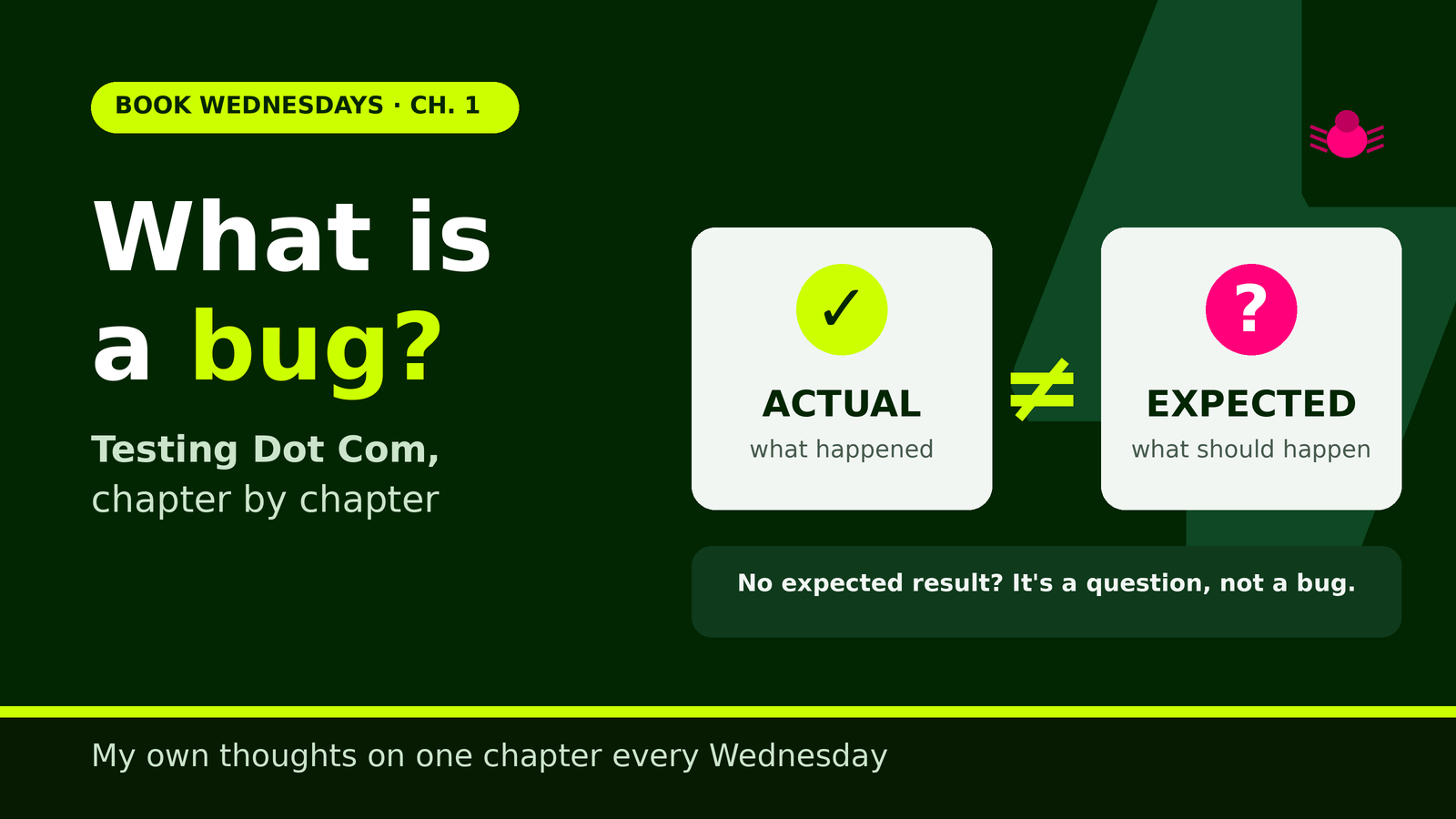
The chapter starts with a simple idea: a bug is the gap between the actual result and the expected result. To call something a bug you need three things: you know what happened, you know what should have happened, and you know the two are different.
My thought: almost all the hard work in QA hides in the second point. Seeing what happened is easy. Knowing what should happen is the real job. So when I can't state the expected result, what I've found is not a bug yet, it's a question. I take it to the product team instead of guessing. A guess dressed up as a bug costs everyone time; a clear question costs one answer.
The book names the spec as the main source of the expected result, and then lists the others: experience, common sense, talking to colleagues, established standards, statistics, an authority's opinion. What has aged: in 2007 the spec was a formal document. Today it's a ticket, a prototype, a discussion, sometimes a chat thread. What hasn't aged: ask "what exactly do we expect here?" before anything else, and keep the answer in writing.
The author also suggests a small exercise: start noticing "bugs" in everyday life and write them down as expected vs. actual. Try it today and see how often the vague part is the expected one.
Where do you take the expected result from when the spec is silent? Tell me in the comments.
Next Wednesday: chapter 2, the goal of testing. Mondays and Fridays stay as they are: my own posts about how quality works in a real product.
📞 Have a QA question? Book a free 15-min call with me via the widget on my profile, or just message me in chat.